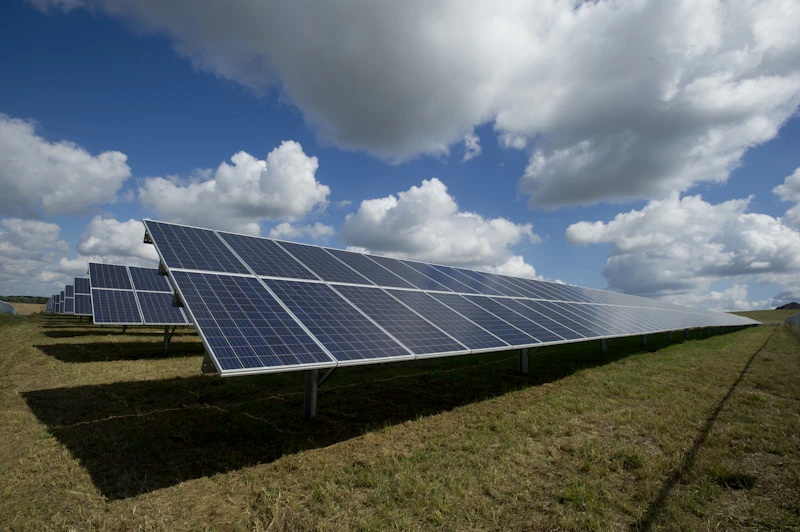
Follow the sun for 25–35% more energy generation compared to fixed-tilt systems. Maximise every hour of Rajasthan's abundant sunshine.
Unlike fixed-tilt solar panels installed at a static angle, solar trackers are motorised mounting systems that continuously orient solar panels toward the sun throughout the day — and in the case of dual-axis trackers, throughout the seasons too.
By maintaining near-perpendicular alignment with incoming solar radiation, trackers dramatically reduce the cosine-effect losses that cut into fixed-tilt yields during morning, evening, and winter months.
Both single-axis and dual-axis systems outperform fixed-tilt installations — the right choice depends on your land constraints, budget, and energy goals.
Rotates panels along a north-south horizontal axis, following the sun's east-to-west daily journey. The industry's most widely deployed tracker technology for large-scale solar farms.
Ideal for utility-scale and large C&I projects where maximising MWh output per rupee of investment is the primary objective.
Adds a secondary tilt axis to track both the sun's daily east-west movement and its seasonal north-south declination — maintaining near-perpendicular alignment throughout every day of the year.
Ideal for sites where land area is limited and maximising kWh output per square metre of panel area is critical to project economics.
Solar trackers are not just a premium upgrade — for the right project profile, they fundamentally change the economics of solar generation.
By staying perpendicular to the sun throughout the day, trackers capture significantly more peak-sun-hour equivalents, particularly in early morning and late afternoon when fixed panels suffer steep cosine losses.
The incremental CapEx of a tracker system is offset by the substantial increase in annual generation revenue. Across a 25-year project life, trackers typically deliver significantly higher cumulative returns than equivalent fixed-tilt installations.
More kilowatt-hours from the same inverter, cabling, and land area means a lower cost per unit of electricity produced. Trackers often reduce LCOE by 8–12% compared to fixed-tilt systems at the same site.
Trackers extend the peak-generation window, producing more power during morning and evening hours when grid demand — and in some markets, power prices — are highest. This improves revenue under time-of-day tariff structures.
Because trackers generate more energy per panel, fewer panels are needed to meet a given MW target — reducing the total land footprint, civil works, and balance-of-system costs compared to an equivalent fixed-tilt plant.
Every FGPS tracker installation includes SCADA-connected monitoring with real-time position telemetry, yield analytics, fault detection, and remote wind-stow control — providing complete operational visibility from anywhere.
Tracker technology delivers the greatest value at specific project types where land, irradiance, and energy economics align.
Large industrial campuses and special economic zones often have significant land parcels within their boundaries. Single-axis tracker arrays on these sites maximise generation during working hours, directly reducing daytime grid consumption and demand charges for tenant businesses.
Discuss your industrial project →For merchant power plants and projects selling under PPAs, tracker systems significantly improve the energy yield projection that underpins financial modelling and debt financing. Rajasthan's Class A solar irradiance makes it one of India's highest-return tracker markets.
Explore utility-scale options →Combining single-axis trackers with elevated panel mounting allows crops to grow beneath the array while the panels rotate overhead. Trackers enable controlled shading schedules that can reduce crop water stress while maintaining high energy output — transforming agricultural land into a dual-income asset.
Learn about agrivoltaics →Businesses with available ground area adjacent to their facilities — logistics centres, cold-storage parks, data centres — benefit from dual-axis tracker systems that maximise kWh output from a constrained footprint, providing maximum self-consumption and the strongest possible commercial solar ROI.
Talk to our commercial team →A sample of FGPS Solar's installed tracker portfolio across Rajasthan and beyond.
Everything you need to know about solar tracker maintenance, performance, costs, and long-term returns before making your decision.
Our solar engineering team is based in Jaipur and available to walk through your specific site conditions, energy targets, and financial modelling in detail.
Talk to an engineer →Solar trackers have fewer moving parts than most people expect. Single-axis systems typically require bi-annual inspection of drive motors, gearboxes, and control electronics — roughly 1–2 additional maintenance visits per year compared to a fixed-tilt installation. FGPS Solar includes remote diagnostics in all tracker installations, allowing our team to identify issues before they affect generation. Many drive systems now carry 10-year warranties, and with Rajasthan's dry climate, corrosion-related maintenance is minimal.
All modern tracker systems include automatic wind-stow algorithms. When anemometers detect wind speeds exceeding a pre-set threshold (typically 12–15 m/s), the tracker controller automatically rotates panels to a near-horizontal stow position (usually less than 8° from horizontal). This dramatically reduces the wind load on the structure. The systems can be configured to stow based on forecast data as well as real-time measurements. FGPS Solar designs all tracker foundations to local wind zone specifications, with safety factors exceeding BIS standards.
Single-axis tracker systems typically add ₹8–14 lakh per MW over equivalent fixed-tilt installations, representing a 10–18% capital cost premium depending on terrain and scale. However, the 20–26% increase in annual energy generation means the incremental investment usually pays back within 3–5 years and generates significantly more cumulative revenue over the project's 25-year life. Dual-axis trackers carry a higher premium (20–28%) and suit sites where land constraints make maximising output per panel the highest priority.
Quality solar tracker structures are designed for a minimum 25-year operational life, aligned with the lifespan of the solar panels they carry. Drive motors and control electronics typically carry 10-year warranties and are field-replaceable at low cost. The structural steel components — galvanised or hot-dip coated — are engineered for 30+ years in Indian climatic conditions. FGPS Solar sources tracker hardware only from manufacturers with proven long-term reliability track records and local spare-parts availability in India.
For a typical 10 MW project in Rajasthan, a single-axis tracker system will generate approximately 220–260 MU additional electricity over 25 years compared to an equivalent fixed-tilt system. At ₹4/kWh average realisation, this represents ₹8.8–10.4 crore in additional revenue against an incremental tracker investment of roughly ₹1–1.4 crore — a net additional return of ₹7–9 crore. This assumes conservative degradation and no time-of-day premium for extended peak-hour generation, so actual outperformance is often higher. FGPS Solar provides detailed site-specific 25-year financial modelling for all tracker proposals.
From rooftop installations to large-scale EPC projects — FGPS Solar delivers complete solar solutions across Rajasthan and India.
Residential and commercial rooftop installations with net metering and subsidy support.
Learn more →Fixed-tilt and tracker ground-mount systems for utility and C&I scale projects.
Learn more →End-to-end engineering, procurement, and construction for solar projects of any scale.
Learn more →Dual-use solar installations that combine energy generation with active agriculture.
Learn more →